Stop blaming willpower for “self-sabotage.” Understand the conflict between your conscious goals and unconscious programming, and learn how nervous system regulation creates lasting change without the white-knuckling.


Self-sabotage. Willpower. Two concepts that place all the blame on you; and miss the point entirely. The real story is happening somewhere you can’t see: your unconscious mind. Here’s what’s actually going on.
You make a decision. A real one. You’re going to eat better, set the boundary, stop going back to that person, follow through this time. You mean it. And for a while; maybe a day, maybe a week; you do.
Then something shifts. You don’t do the thing. Or you do the exact opposite. And before long you’re sitting with the familiar weight of it: Why do I keep doing this? What is wrong with me?
Nothing is wrong with you. But something very important is happening; and it’s happening somewhere your conscious mind doesn’t have access to.
Two Minds, One Person
Most of us walk around believing we are our thoughts. That the voice narrating our day; making plans, setting intentions, reasoning through decisions; is the one running the show. It isn’t.
The human mind operates on two levels simultaneously. The conscious mind is the part you’re aware of: your logic, your language, your intentions, your goals. It’s analytical, deliberate, and slow. It’s also, by most estimates, responsible for roughly 5% of your behaviour.
The other 95%? That’s the unconscious mind. And it has been running in the background your entire life.
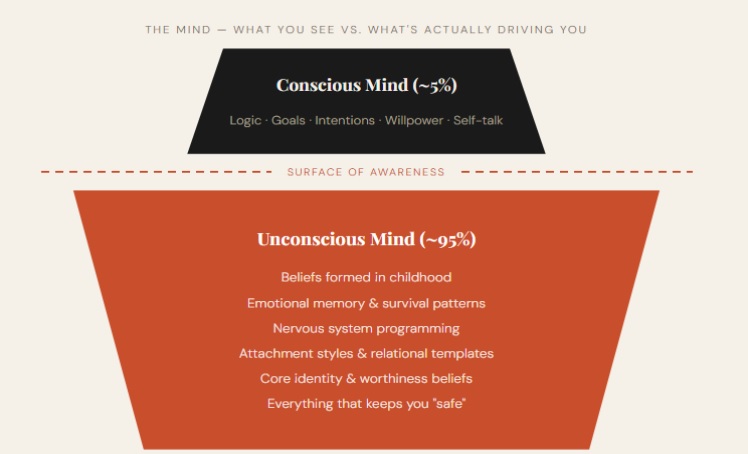
The unconscious is not mysterious or mystical. It’s simply the vast storehouse of everything your brain has learned, experienced, and encoded; mostly before you were old enough to have any say in it. It stores your beliefs about safety, about love, about what you deserve, about what happens when you succeed or fail or trust someone. And it runs on automatic, continuously, influencing every choice you make.
Here’s the critical part: when the conscious and unconscious are in conflict, the unconscious wins. Every time.
So, What Is "Self-Sabotage," Really?
When we say someone is self-sabotaging, we’re describing a gap; a visible gap between what a person says they want and what they actually do. But we’re explaining it wrong. We’re treating it as a character flaw, a failure of resolve, a sign that deep down they don’t really want it.
What we’re actually watching is two parts of the mind in direct conflict. The conscious mind has a new goal. The unconscious mind has an old program. And the old program almost always has more horsepower.
But it’s important to know, the unconscious isn’t working against you. It’s working for the version of you that needed protecting; usually a much younger version, in circumstances that no longer exist. The problem isn’t the program. It’s that the program hasn’t been updated.
Willpower: A Conscious-Mind Tool in an Unconscious-Mind Fight
Willpower lives entirely in the conscious mind. It’s the deliberate, effortful application of reason to override impulse. And there’s nothing wrong with it as a tool. The problem is that we’ve been taught to use it as the primary solution to problems that are rooted in the unconscious.
Trying to override an unconscious pattern with willpower is like trying to stop a river with your hands. You can hold it back for a while. You might even get quite good at it. But it’s exhausting, it’s unsustainable, and the moment your hands slip; through stress, fatigue, overwhelm, or just an ordinary bad day; the river goes where it was always going to go.
There’s also a biological limit that makes willpower an even more unreliable strategy: it depletes. The research on this is robust. Your brain’s capacity for self-regulation is a finite resource. Every decision you make, every stressor you absorb, every moment you override an impulse draws from the same well. When the well is dry; and for people carrying significant stress, grief, or chronic pressure, it empties fast; willpower isn’t available. Not because you’re weak. Because you’re human and the tank is empty.
The Nervous System as the Bridge
Here’s where the nervous system becomes essential to understand, because it is quite literally the physical mechanism through which the unconscious communicates with your body and your behaviour.
Your nervous system has been cataloguing threat and safety since before you were born. By the time you’re an adult, it has an elaborate, largely unconscious map of what danger looks like, what safe feels like, and what to do when either is detected. And it acts on that map automatically, before your conscious mind has even registered what’s happening.
This is why insight alone often isn’t enough. You can understand, rationally and completely, why you do something; and still do it. Because understanding happens in the conscious mind. The pattern lives in the body, in the nervous system, in the unconscious. Knowing why the river flows the way it does doesn’t redirect the river.
When the nervous system detects something it has coded as “dangerous”; even when that something is a promotion, a healthy relationship, or a moment of real stillness; it responds. Heart rate changes. Breathing shifts. The body moves toward familiarity and away from the perceived threat. The conscious mind might be saying yes. The nervous system might be screaming abort.
That’s not self-sabotage. That’s a highly efficient threat-detection system responding to old data.
What Actually Creates Change
If willpower alone doesn’t work, and insight alone doesn’t work, then what does?
Real, lasting change; the kind that doesn’t require white-knuckling; happens when you work at the level of the unconscious. That means different things for different people, but it tends to involve a few common threads.
- Making the unconscious conscious. This is foundational work. Becoming curious about the patterns rather than ashamed of them. Asking: what does this behaviour protect me from? When did I first learn this? What did I need then that I’m still trying to get now? Therapy, journaling, reflective practice; these are tools for that excavation.
- Nervous system regulation, not just management. Not just coping with stress, but actually expanding your window of tolerance so that things that used to feel threatening become more navigable. This is body-based, relational work. It happens through safety, repetition, and co-regulation with others who are regulated themselves.
- New experiences, not just new thinking. The unconscious updates through experience far more than through logic. Every time you do something that contradicts an old belief; stay when the old pattern would leave, speak up when the old pattern would go quiet, receive care when the old pattern would deflect; you are laying down new neural pathways. Slowly. Imperfectly. But actually.
Reducing the demand on willpower by changing the environment. Build structures that make the desired behaviour easier and the old behaviour harder. Reduce decision fatigue. Get support. This isn’t cheating; it’s working with the brain instead of against it.
Closing the Story
The language we use about ourselves matters more than most people realize. “I self-sabotage” is a closed story. It’s a verdict. It puts you on trial for being human and finds you guilty.
“I notice I pull back when things feel too good; and I’m getting curious about where that comes from” is an open story. It’s the beginning of something.
You deserve the open one.
Book a Consultation
It’s easy and free!